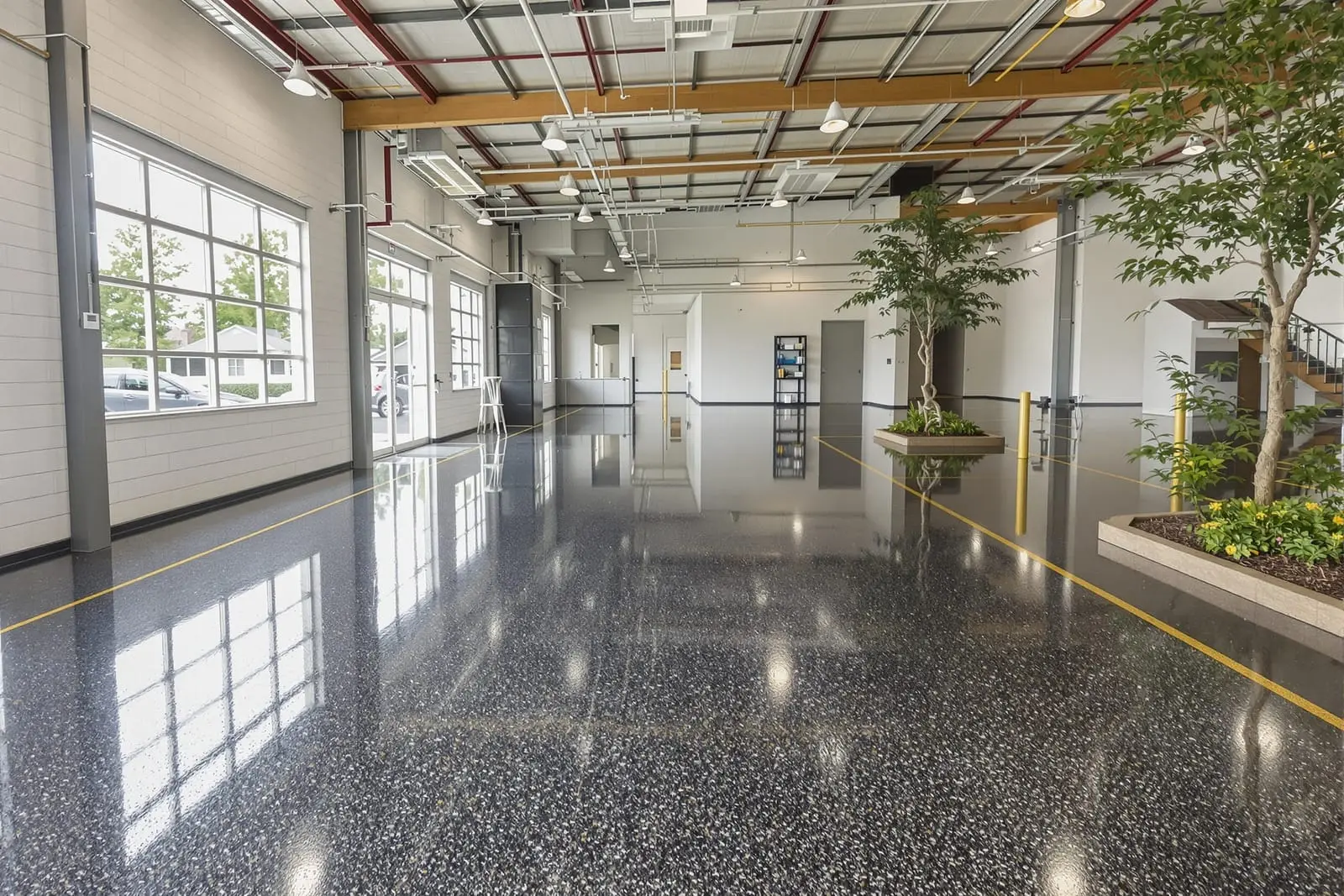
Keep operations smooth with industrial concrete floors in Atlanta, GA. We build warehouse slabs designed for forklift traffic, racking, and heavy loads. Our crews focus on flatness, durability, and joint layout to reduce maintenance. Install a floor system that supports your production and storage needs for years.
Primetime Concrete Atlanta provides professional industrial concrete floors throughout Atlanta, GA and the surrounding area. Our licensed, insured crew delivers safe, clean, on-time work with a free estimate before anything begins. Call (470) 970-2915 or request your free quote.
Industrial Concrete Floors for Atlanta Warehouses and Plants
Primetime Concrete Atlanta designs and installs industrial concrete floors that match the real demands of Atlanta warehouses, distribution centers, and manufacturing plants. We focus on slabs that handle heavy forklift traffic, racking systems, and constant loading without joint blowouts or surface raveling.
In the Atlanta area, many industrial buildings were built in the 1970s through early 2000s with thinner slabs, limited reinforcement, and minimal vapor control. When these spaces are upgraded for modern logistics, the existing floors often crack, curl, or spall under higher loads. Our team evaluates the actual use of your space, including forklift axle loads, rack post loads, and anticipated impact areas, then engineers a floor system that fits the structure you have and the work you plan to do.
We are familiar with conditions around Fulton Industrial, South Atlanta, Norcross, and the I-20 and I-285 corridors. Local soils, high humidity, and temperature swings all affect slab performance. Primetime Concrete Atlanta accounts for these factors in our mix designs, control joint layout, curing methods, and moisture mitigation strategies so you get a floor that stays level and serviceable for the long term.
How We Design Warehouse & Industrial Concrete Floors
A durable industrial floor starts long before the first truck arrives on site. We begin with a load and use assessment, where we confirm rack layouts, aisle widths, equipment types, and whether you plan to use narrow aisle lifts, heavy reach trucks, or automated guided vehicles. This information determines slab thickness, reinforcement, and joint spacing.
Next we review geotechnical data or, for existing buildings, the performance of the current slab and subgrade. If needed, we coordinate soil testing to determine bearing capacity and shrink/swell potential, which is especially important on certain Atlanta-area clays. Where subgrade variability is high, we might recommend thicker granular base, soil stabilization, or localized undercutting.
Primetime Concrete Atlanta then develops a floor specification that covers compressive strength (often 4,000 to 5,000 psi for industrial use), reinforcement type (rebar, mesh, or steel fiber), vapor barrier requirements, surface flatness (FF) and levelness (FL) targets, and joint design. On renovation projects we also consider how new slab elevations must coordinate with existing dock heights, door thresholds, and machine bases so the new floor integrates smoothly with existing infrastructure.
Installation Process and Quality Control on Site
Execution in the field is where industrial concrete floors succeed or fail. For new construction, we start by preparing and proof rolling the subgrade, then installing and compacting a crushed stone base to achieve consistent support. In older Atlanta warehouses, we often discover soft spots from prior plumbing trenches or poorly compacted fill. We correct these areas before any concrete is poured so you do not end up with differential settlement or localized cracking.
We install vapor barriers and edge isolation where required, then place reinforcement and dowels according to the engineered plan. Concrete placement is scheduled to match Atlanta weather patterns, avoiding extreme heat in midsummer afternoons when possible to reduce rapid surface drying and plastic shrinkage cracking.
Primetime Concrete Atlanta uses laser-guided screeds on larger projects to meet specified FF and FL numbers, which is critical for high-bay racking, wire-guided forklifts, and sensitive equipment. Our crews continuously check slab thickness, flatness, and joint alignment during the pour. Finishing is timed carefully to avoid surface burnishing that can trap moisture or cause delamination, yet still provide the abrasion resistance an industrial environment requires.
Material Options and Surface Treatments for Heavy Use
Industrial concrete floors are not one-size-fits-all. Depending on how you use your facility, we recommend different combinations of mix designs and surface treatments.
For high traffic forklift aisles and staging zones, many Atlanta facilities choose hardened and densified concrete. We often specify a mix with a low water-cement ratio for strength and reduced permeability, combined with a dry shake hardener or post-applied lithium or sodium silicate densifier. This produces a tight surface that resists dusting and holds up to steel-wheeled and polyurethane-tired traffic.
If you need enhanced chemical resistance, such as for food processing, automotive fluids, or light manufacturing, we can polish and densify the slab, then install an appropriate sealer or coating system on top. Polished concrete with guard products is common in distribution centers that value both brightness and minimal maintenance. In areas with frequent impact, such as around dock levelers and loading bays, we may incorporate steel fibers or localized thickening and heavier reinforcement to prevent corner cracking and edge failures.
Primetime Concrete Atlanta also designs joint details around your operations. For aggressive forklift traffic, we often recommend armored joints or well-anchored joint nosings to protect slab edges, reduce impact loading, and limit ongoing repair costs.
Common Industrial Floor Problems in Atlanta and How We Address Them
Older warehouse and industrial buildings around Atlanta often struggle with curling slabs, random cracking, and joint spalling. These problems usually stem from a combination of inadequate subgrade support, poor joint layout, high shrinkage mixes, and heavy traffic patterns the original floor was never designed to handle.
Primetime Concrete Atlanta approaches these issues systematically. For slabs with widespread joint damage, we analyze the cause first. If racking has been rearranged and higher loads are now sitting near a joint, we may recommend retrofitting with dowels, replacing joint nosings, and installing semi-rigid epoxy joint fillers designed for hard industrial tires.
When moisture vapor transmission pushes through older slabs, it can ruin coatings, adhesives, and sensitive inventory. We perform calcium chloride or in situ RH testing when appropriate, then propose solutions such as topical moisture mitigation, heavy-duty vapor barriers beneath replacement slabs, or breathable finishes that tolerate higher moisture. Where slab curl creates trip hazards or rail misalignment, we can grind and re-profile the surface, adjust joint filling strategies, or in severe cases replace affected panel strips with more stable mix designs and reinforcement configurations.
Because Atlanta humidity and temperature swings can exacerbate shrinkage and expansion, we also focus on proper curing. On new work, we use curing compounds, wet curing, or a combination, chosen to match the planned surface treatment so the floor gains strength evenly and resists early age cracking.
Cost Factors for Warehouse & Industrial Concrete Floors
Industrial concrete floors are a major investment, and understanding what drives cost helps you plan realistically. The most significant variables are slab thickness, reinforcement strategy, and surface specification. A light-use 6 inch slab for basic storage will price differently than an 8 or 10 inch slab designed for high-bay, high-load ASRS systems or very heavy rack posts.
Flatness and levelness tolerances are another major factor. Floors designed for standard forklifts can use moderate FF and FL values. Facilities using very narrow aisle lifts, wire guidance, or tall racking often require tighter tolerances, which means more detailed subgrade work, specialty equipment, and additional quality control time.
Existing conditions also influence cost. In some older Atlanta industrial parks, we find poor drainage or subgrade failures that must be corrected before new slab work begins. Full depth replacement in these conditions includes demolition, disposal, subgrade stabilization, and sometimes new under-slab utilities. These steps add cost but are often necessary for long-term performance.
Primetime Concrete Atlanta provides detailed, line-item proposals so you can see the cost difference between options like standard joint systems versus armored joints, conventional reinforcement versus steel fibers, or basic cured slab versus densified and polished finishes. This transparency allows facility managers, owners, and tenants to choose the combination of performance, upfront cost, and maintenance profile that best matches their operations and lease terms.
Why Atlanta Facilities Choose Primetime Concrete Atlanta
Selecting a concrete contractor for industrial floors is different than choosing one for residential or light commercial work. You need a team that understands how your operations interact with the slab day after day. Primetime Concrete Atlanta has installed and repaired warehouse and industrial concrete floors in active facilities across the metro area, including logistics centers, manufacturing plants, cold storage, and mixed-use industrial properties.
We coordinate closely with general contractors, engineers, and facility managers to minimize disruption. For many occupied warehouses, we phase work so that only certain aisles or dock positions are offline at a time, sequencing pours, cure times, and joint cutting around your shipping and receiving schedule.
Our focus is on measurable performance. Before we start, we establish clear expectations for slab thickness, strengths, FF/FL levels, and joint layout. During the job, we test and document results so you have a record for future reference, lease negotiations, or equipment warranties. After completion, we walk you through recommended maintenance practices such as cleaning methods that will not damage densifiers or sealers and inspection routines that catch minor joint or crack issues before they expand.
If you are planning a new warehouse, expanding an existing facility, or dealing with a failing industrial floor anywhere in the Atlanta area, Primetime Concrete Atlanta is ready to evaluate your space and provide a solution that fits how you actually work, not just what looks good on paper.
“
Professional warehouse & industrial concrete floors, done right the first time, quality materials, honest pricing, and results that last.
Primetime Concrete Atlanta
Warehouse & Industrial Concrete Floors Across Our Service Area