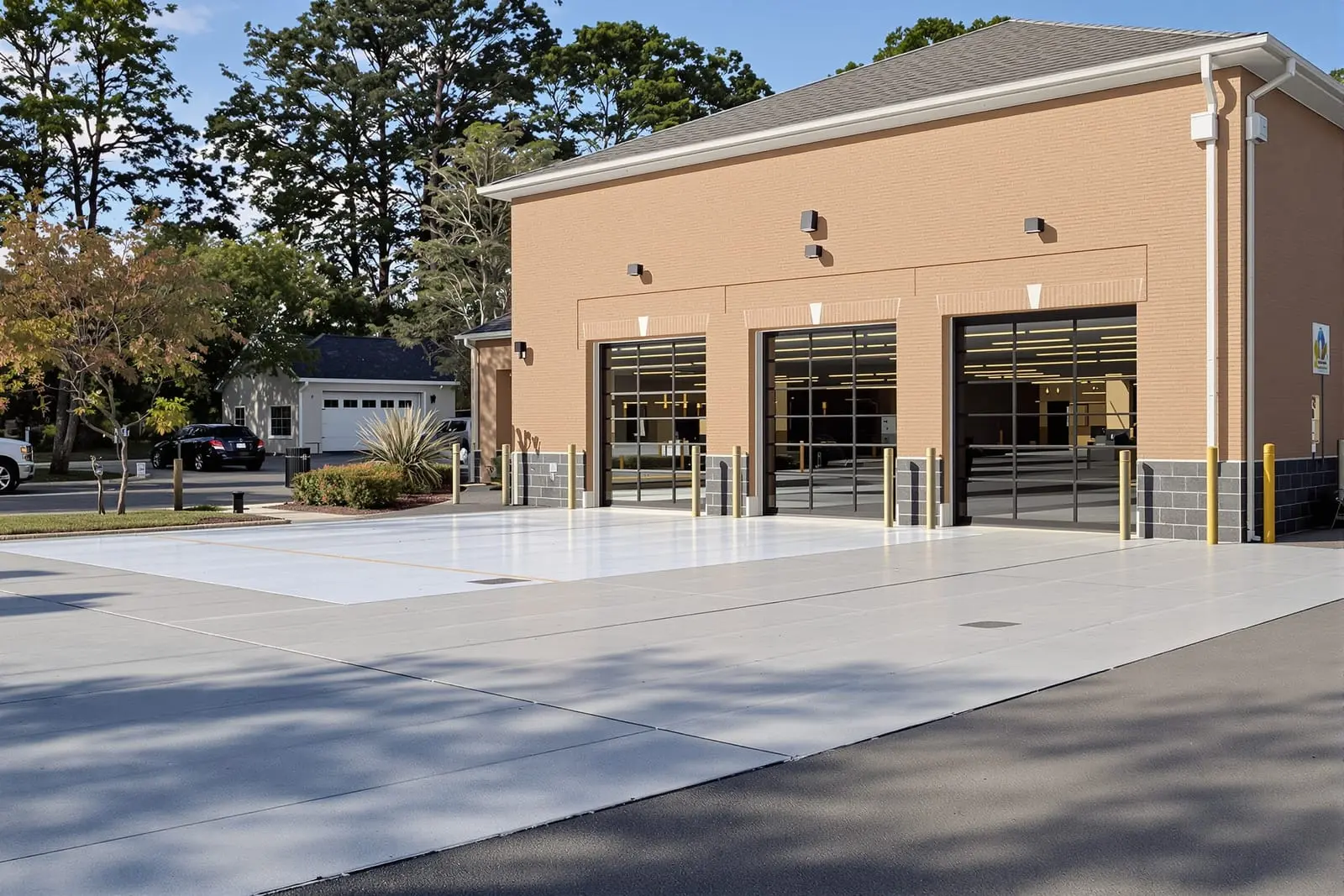
Handle truck traffic with a robust commercial concrete slab in Atlanta, GA. We construct loading docks, approach slabs, and equipment pads for daily use. Our work includes proper reinforcement, thickness, and finishes to resist impact and wear. Keep shipping and receiving areas smooth, safe, and efficient.
Primetime Concrete Atlanta provides professional commercial concrete slab throughout Atlanta, GA and the surrounding area. Our licensed, insured crew delivers safe, clean, on-time work with a free estimate before anything begins. Call (470) 970-2915 or request your free quote.
Loading docks and commercial slabs built for Atlanta businesses
If you move heavy freight in or out of your building, your concrete loading docks and commercial slabs take more abuse than almost any other surface on your property. Forklifts, pallet jacks, box trucks, and 53-foot trailers all put concentrated loads on small points of concrete. Primetime Concrete Atlanta designs and pours commercial concrete slabs that are built specifically for the way Atlanta businesses operate, whether you are in a Westside warehouse, a distribution hub near the airport, or a tight in-town site along the BeltLine.
Instead of treating your project like a generic parking lot, we look at the turning paths of trucks, where forklifts actually travel, where dock levelers will sit, and how water drains off the slab. Those details are what keep slabs from breaking down early. If you handle food, packaging, or high-volume shipping, the right slab design is just as important to your operation as the dock equipment and racking inside your building.
How we design a commercial concrete slab that holds up
A durable commercial concrete slab starts with understanding loads and traffic, not just choosing a concrete mix. At Primetime Concrete Atlanta, we begin with a site visit to walk the dock area, look at existing cracks or settlement, and confirm soil conditions. In many parts of metro Atlanta, especially older industrial sites, we see mixed fill soils or previous slabs that were simply paved over. We probe and, if needed, coordinate soil testing so we are not pouring new concrete over a weak base.
Based on how you use the space, we size the slab thickness (often 6 to 8 inches for typical warehouse traffic, thicker where trailers park or container chassis stand), specify rebar or welded wire reinforcement, and design the subbase. For heavy freight or constant forklift traffic, we usually recommend compacted crushed stone under the slab and #4 or #5 rebar on an engineered spacing grid. For lighter commercial use, such as small delivery vans and pallet jacks, we may use a high-quality fiber reinforced mix with targeted reinforcement at joint locations.
We also factor in water and temperature. Atlanta can have intense rain followed by heat, which is tough on concrete. We set slopes so that stormwater moves away from dock doors, not toward them, and we include proper control and expansion joints to help manage shrinkage and thermal movement. For existing buildings, we look at how our new slab will tie into the structural slab or footings at dock pits, posts, and building columns, so you do not end up with a trip edge or crack line where old and new concrete meet.
Our installation process for loading docks and dock-high slabs
When it is time to build or replace your loading dock concrete, careful preparation often matters more than the concrete truck that arrives later. First, Primetime Concrete Atlanta will sawcut and remove any existing slab or asphalt in the work area and haul it off for proper disposal or recycling. We then excavate to the designed depth and compact the subgrade with plate compactors or rollers, checking for soft spots that could later cause slab settlement.
Next, we install and compact the aggregate base, typically 4 to 8 inches of graded crushed stone, and set forms to the exact elevations needed for dock heights, ramps, and approaches. For dock-high facilities around Atlanta, we usually coordinate with your dock leveler specs and trailer heights so the finished concrete meets equipment tolerances. Rebar or mesh is then placed on chairs so it ends up in the middle of the slab, not sitting directly on the base where it does little good.
When ready, we pour a commercial-grade concrete mix, often 4,000 to 5,000 psi with air entrainment when the slab is exposed to weather. The crew uses vibrators and screeds to consolidate and level the slab, then finishes it with a broom or trowel texture, depending on whether you need traction for forklifts in the rain or a smoother interior surface. We cut control joints at the correct spacing for the slab thickness to help control where any inevitable shrinkage cracks appear. Proper curing is the last critical step. We keep the slab properly moist or apply a curing compound so the surface does not dry too quickly in the Georgia sun, which reduces dusting and early surface wear.
What affects cost for a commercial concrete slab in Atlanta
Business owners often ask why one loading dock or commercial concrete slab bid can be higher than another. Most of the price is driven by thickness, reinforcement, access, and what has to happen below the concrete. A heavy-duty slab behind a distribution center off I-285 that sees constant 18-wheeler traffic will typically be thicker, use more steel, and require deeper base preparation than a light-duty slab for a catering company that receives box truck deliveries twice a day.
Existing site conditions matter a lot in metro Atlanta. If we find poorly compacted fill behind an older brick warehouse or a previous asphalt lot with buried debris, we may recommend undercutting and replacing unstable soil with clean compacted stone. It adds some upfront cost but saves you from slab failure and forklift repairs later. Access can also change labor and pump costs. A tight Midtown site with limited truck access and night work will usually cost more per square foot than an open Greenfield site near Fairburn or Lithia Springs.
Finishing requirements and add-ons also influence price. If you need heavy-duty steel angle dock nosings, embedded anchor bolts for guardrails, or thickened edges at roll-up door openings, we include that in the design and estimate. Sealer applications, line striping, and forming complex dock ramps or trench drains will be separate line items so you can see exactly where your money is going. Primetime Concrete Atlanta is always transparent about these cost drivers and will walk you through options that balance durability with your budget.
Common loading dock problems we prevent and repair
Because we work across Atlanta’s industrial and commercial areas, we see the same loading dock issues over and over: broken concrete at dock edges, ponding water in front of doors, settled slabs away from dock levelers, and interior warehouse slabs that rattle pallet jacks due to joint spalling. Primetime Concrete Atlanta focuses on preventing those issues from day one and has repair strategies if you already have them.
For new work, we thicken the slab at high impact points like dock edges, trailer stands, and forklift transition areas. We design joint layouts to avoid joints landing exactly at wheel paths when possible, and we use proper dowels at construction joints so adjacent slab panels move together instead of pumping and breaking apart under traffic. Surface slopes are carefully checked with laser levels during the pour so water does not sit in front of overhead doors or run back toward your building.
If your existing loading dock is already failing, we can sawcut and replace only the damaged sections, rather than tearing out everything. Often, we will install new dowels to lock the fresh slab into the remaining sound concrete and rebuild failed bases underneath the worst areas. In some cases we can recommend joint stabilizing or slab lifting options if settlement is the main issue. Before we leave, we will walk the dock with you and point out maintenance tips like when to reseal joints and how to avoid overloading small slab areas with stacked pallets or temporary containers so your new commercial concrete slab gives you many years of service.
“
Professional loading docks & commercial slabs, done right the first time, quality materials, honest pricing, and results that last.
Primetime Concrete Atlanta
Loading Docks & Commercial Slabs Across Our Service Area